Technology Overview
The AI technology stack for commerce — foundational models, agentic AI, LLMs, privacy & security, investment costs, and what comes next — based on Book Part 5 of the AI Best Practices for Commerce reference.
Investment & Cost Considerations
The economics of making AI work sustainably
AI Cost Structure Fundamentals
Artificial intelligence has transitioned from a speculative frontier to a mainstream technology shaping strategic decisions across industries. Its adoption, however, is not purely a technical matter; it is fundamentally an investment decision. Implementing AI at scale requires capital, operational budgets, infrastructure planning, vendor evaluation, and a financial understanding of how AI integrates into the broader economic structure of an organization.
This chapter examines the multifaceted economic landscape of artificial intelligence, exploring the cost drivers, investment models, resource consumption patterns, tokenization pricing schemes, infrastructure choices, and long-term financial implications of AI deployment. It aims to provide a holistic perspective that can help decision-makers assess not only how AI works, but what it truly costs to make it work sustainably.
Artificial intelligence brings with it both a promise and a paradox. On one hand, AI has the power to reduce operational costs, automate processes, increase productivity, and unlock new value streams. On the other hand, it introduces cost structures that are unique, evolving, and dependent on computational intensity, data availability, and ongoing maintenance.
AI requires organizations to rethink traditional budgeting distinctions between capital expenditures and operating expenditures, evaluate cloud consumption models with unprecedented granularity, and understand how usage-based pricing—especially the token-based pricing of large language models—transforms the economics of software. The financial calculus of AI cannot be reduced to a single line item; it is a confluence of infrastructure, talent, data, governance, energy, experimentation, and continuous iteration.
Investing in artificial intelligence requires reconceptualizing what “building technology” means. In traditional IT projects, initial capital expenditure often dominates; once the system is deployed, operational costs tend to stabilize. With AI, however, the lifecycle introduces ongoing financial commitments that persist long after initial deployment. The cost of computing increases proportionally with the scale of models, the volume of data, and the variety of use cases. AI systems evolve continuously, requiring retraining, fine-tuning, monitoring, and updates that introduce recurring expenses.
Artificial intelligence also shifts costs toward usage-based consumption models. Cloud-based AI services, particularly those exposed through APIs, rely on billing mechanisms that track tokens, computational cycles, storage, and bandwidth. This creates financial unpredictability: Expenses correlate with user interaction patterns rather than fixed licensing fees. While this provides flexibility, it requires sophisticated forecasting and cost-governance strategies to avoid unexpected overruns. Organizations that underestimate the variability of AI consumption may find that adoption accelerates faster than anticipated, driving costs beyond initial projections.
CAPEX and OPEX distinctions become blurred. Capital expenditures traditionally refer to hardware, infrastructure, and long-term assets. Operating expenditures encompass services, compute consumption, and support. In AI ecosystems, much of the investment migrates toward OPEX, because the most significant cost drivers—cloud compute, training cycles, fine-tuning, inference, and storage—are consumption-based. For organizations with strict budget controls, this shift demands new financial governance mechanisms and closer collaboration between engineering, finance, and procurement teams.
5.6 Investment and Cost Considerations for Artificial Intelligence Systems 479
Another distinctive aspect of AI investment is that it intertwines deeply with organizational readiness. Costs are not limited to technology; they extend to hiring or upskilling personnel, reorganizing workflows, implementing governance frameworks, and integrating AI into existing processes. The total cost of ownership (TCO) includes these human and organizational dimensions, making AI not merely a software decision but an enterprise-wide transformation with significant cultural implications.
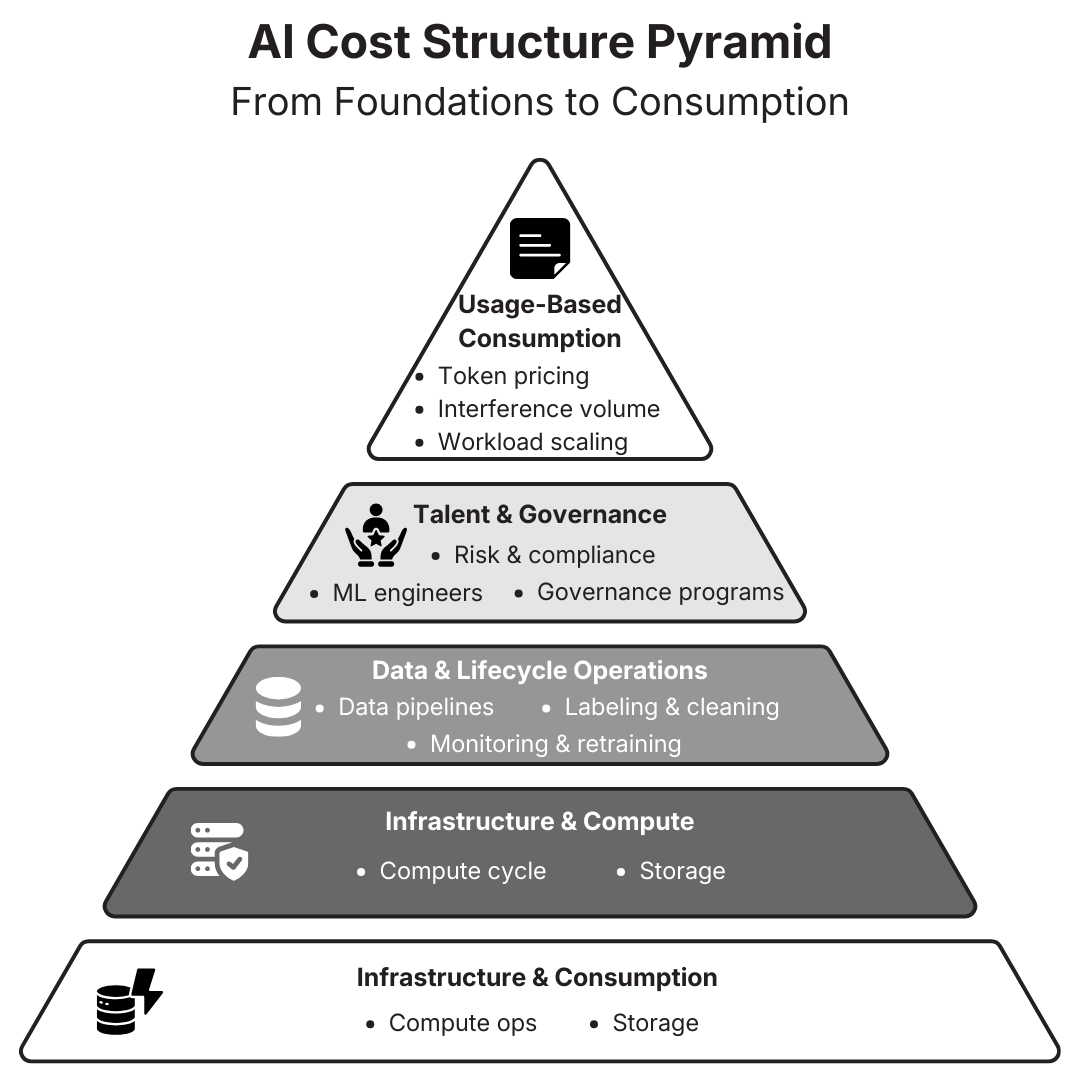
- GPU clusters, cloud instances, on-premise hardware
- Monitoring and retraining compute
- Data versioning and quality management
- Continuous retraining and validation cycles
- Hiring / upskilling specialized AI talent
- Ethics committees, model review boards, legal teams
- API costs scale with user activity
- Multi-step agent workflows compound token consumption
Last updated: March 12, 2026