Technology Overview
The AI technology stack for commerce — foundational models, agentic AI, LLMs, privacy & security, investment costs, and what comes next — based on Book Part 5 of the AI Best Practices for Commerce reference.
Comparing Public LLMs
Which model, for which task, at what cost
Evaluation Framework
The choice of large language model became one of the most consequential technical decisions retailers could make by 2025. But the conversation shifted from “can we use LLMs?” to “which LLM, for which task, at what cost?” The one-size-fits-all approach had given way to portfolio strategies, with companies running multiple models simultaneously based on specific needs and constraints.
Evaluation Framework
Selecting an LLM for commercial retail use requires evaluating eight critical dimensions. These factors determine not just whether a model can perform a task, but whether it can do so reliably and economically at production scale.
Accuracy matters differently across contexts. The cost of being wrong varies dramatically: A product classification error affecting millions of SKUs has different implications than an incorrect chatbot response to a single customer. Retailers learned to measure accuracy not just as a percentage, but in terms of business impact and correction costs.
Reasoning capability separates frontier models from their predecessors. By 2024, models like OpenAI’s o1 series demonstrated step-by-step problem decomposition, spending additional compute time on internal reasoning chains before generating responses. This enabled handling of complex multi-step queries that earlier models couldn’t manage, for example, understanding product recommendations that required considering load-bearing calculations, climate factors, and building codes simultaneously.
Speed determines deployment possibilities. Real-time product search requires sub-200 millisecond responses. Customer service chatbots tolerate 1-2 seconds. Batch processing jobs can take hours. When Anthropic released Claude 3 Haiku in March 2024, its 0.3-second response times for product classification made real-time inventory updates viable. Meanwhile, reasoning models taking 10-30 seconds excelled at back-office analysis but couldn’t support customer-facing applications.
Cost varies wildly and compounds at scale. As of early 2025, pricing ranged from roughly $0.15 per million input tokens for efficient models to $15 per million for frontier capabilities. For retailers processing 100 million product descriptions monthly, this translated to $15,000 versus $1.5 million in API costs, a 100x difference that forced careful model selection.
Tool use and function calling enables LLMs to interact with external systems, checking inventory databases, processing returns, updating order status. Anthropic’s Claude family demonstrated reliable structured tool definitions that reduced error rates in API calls. Function calling capability wasn’t just about whether a model could invoke external functions, but whether it did so reliably with proper error handling and parameter validation.
Context windows determine how much information models can consider simultaneously. Early GPT-3 models in 2020 handled roughly 4,000 tokens, about 3,000 words. By 2024, Claude 3 supported 200,000 tokens (approximately 150,000 words), while Google’s Gemini 1.5 Pro pushed to 1 million tokens in early 2024. This enabled retailers to feed entire product catalog sections, complete customer conversation histories, and policy documentation into single prompts, allowing models to provide answers considering all relevant context.
Multi-modal capabilities, understanding images, video, and audio alongside text, opened entirely new use cases. Google’s Gemini 1.5 Pro could analyze product photos to identify damage, understand assembly instructions from manuals, or compare customer-submitted images against product listings. Meta’s Llama 3.2 models, released in September 2024, brought official vision capabilities to open-weights models for the first time, enabling retailers to run visual understanding on-premise.
Enterprise controls separate experimental technology from production infrastructure. This means data residency guarantees, audit logs, content filtering, rate limiting, and service level agreements. Anthropic’s Claude for Enterprise provided SOC 2 Type II compliance, dedicated capacity commitments, and detailed usage analytics, prerequisites for deployment in regulated industries and large-scale retail operations.
Reliability and uptime distinguish production-ready services from experiments. OpenAI offered 99.9% uptime SLAs for enterprise customers by 2024, translating to roughly 43 minutes of downtime per month. Anthropic is rumored to have provided 99.95% guarantees for dedicated capacity customers. These fractional differences mattered, the gap between 99.9% and 99.95% meant approximately 22 hours versus 4.4 hours of downtime per year for always-on retail operations.
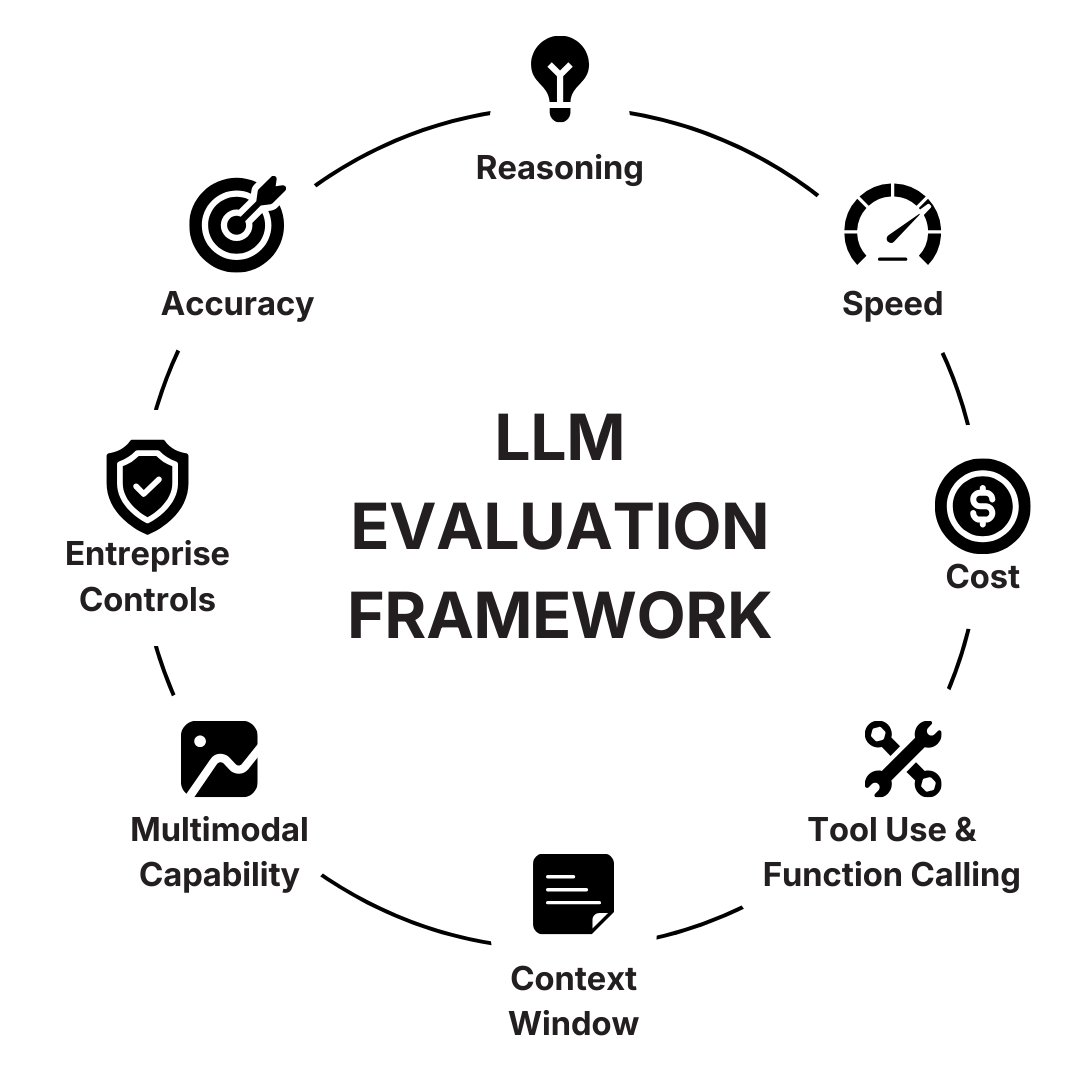
- Accuracy: measure in business impact, not just %
- Reasoning: multi-step decomposition for complex queries
- Speed: <200ms for search, 1-2s for chatbots, hours for batch
- Cost: $0.15–$15 per million tokens (100x range in 2025)
- Context window: 4K tokens (2020) → 1M tokens (2024)
- Multimodal: images, video, audio alongside text
- Tool use reliability: consistent JSON and API call handling
- Enterprise controls: SOC 2, audit logs, data residency
- Reliability: 99.9% vs 99.95% SLA = 39 fewer hours downtime/year
Last updated: March 12, 2026