Technology Overview
The AI technology stack for commerce — foundational models, agentic AI, LLMs, privacy & security, investment costs, and what comes next — based on Book Part 5 of the AI Best Practices for Commerce reference.
Comparing Public LLMs
Which model, for which task, at what cost
Recommendations by Use Case
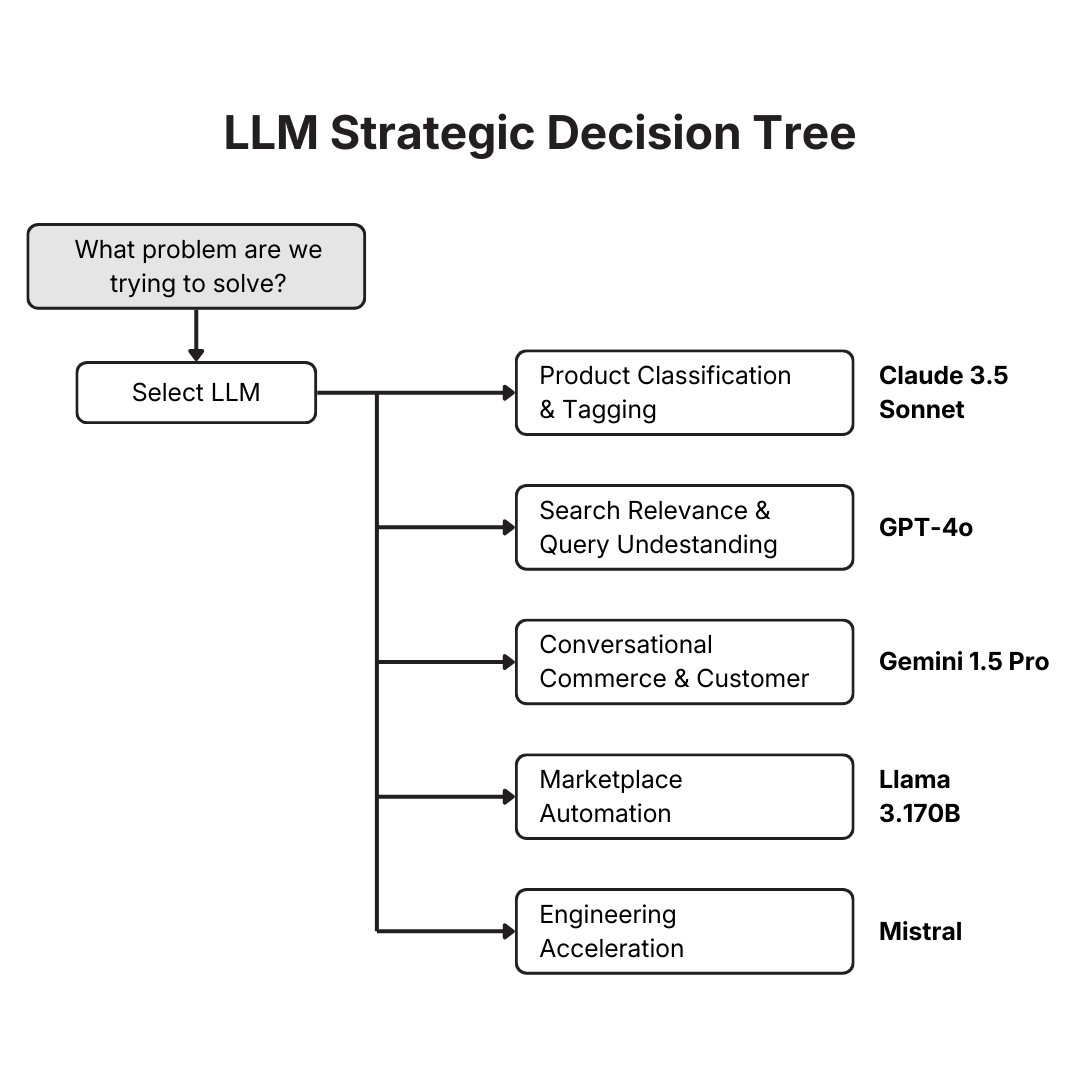
The right model depends on the specific retail problem. Based on capabilities and economics available by late 2024, patterns emerged:
Product classification and tagging: Llama 3.1 70B fine-tuned on custom taxonomies won the economics game for high-volume needs. Self-hosted costs of thousands monthly beat six-figure API fees for processing tens of millions of products. For retailers without GPU infrastructure, Mistral’s smaller models provided a middle ground. Claude Haiku worked well for retailers wanting API simplicity with better-than-budget performance.
Search relevance and query understanding: Claude 3.5 Sonnet emerged strong. Understanding shopping intent requires nuance, as context matters enormously in determining what customers actually seek. Claude’s instruction following and context understanding translated to more relevant results. Gemini 1.5 Pro worked well when visual search was central, particularly for “find similar” functionality.
Conversational commerce and customer service: Claude 3.5 Sonnet dominated. Retailers needed models that wouldn’t hallucinate policies, could reliably call tools to check order status, and handled sensitive customer data appropriately. The combination of accuracy, safety, tool use reliability, and enterprise controls made it pragmatic, despite not being the cheapest option.
Marketplace automation (listing optimization, seller communications, content moderation): GPT-4 excelled at creative content generation for listings. For content moderation, Claude’s constitutional AI training reduced false positives. For high-volume routine communications, Mistral or fine-tuned Llama models provided acceptable quality at sustainable economics.
Internal engineering acceleration (code generation, documentation, data analysis): GPT-4 won on pure capability for generating API integrations and data transformation scripts. Claude worked well for code review and security analysis. Llama Code variants proved surprisingly capable for teams comfortable with self-hosting, particularly when fine-tuned on company-specific code patterns.
Last updated: March 12, 2026