Technology Overview
The AI technology stack for commerce — foundational models, agentic AI, LLMs, privacy & security, investment costs, and what comes next — based on Book Part 5 of the AI Best Practices for Commerce reference.
Privacy & Security
Foundational principles for responsible AI systems
Securing the Full AI Architecture
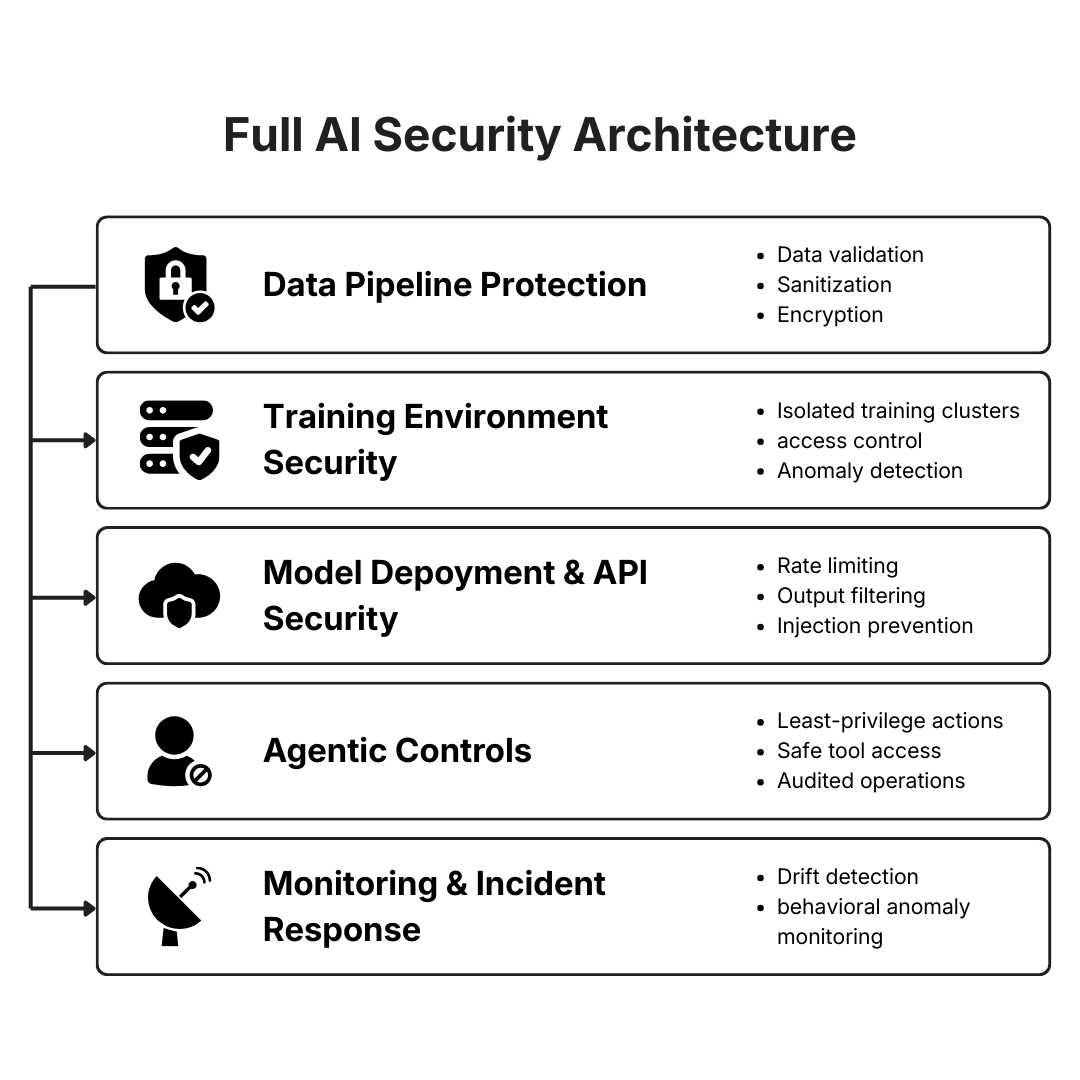
AI systems do not exist in isolation; they operate within broader architectures that include data pipelines, training clusters, deployment platforms, monitoring systems, and external interfaces. Securing an AI system requires securing each component individually as well as understanding how they interact.
The data pipeline is particularly critical. Raw data entering the pipeline must be validated, sanitized, and classified to ensure that harmful or irrelevant data does not contaminate the model. Robust preprocessing ensures that sensitive information is removed when inappropriate and that the remaining data meets quality standards. Secure storage practices must be enforced throughout the pipeline, including encryption, access control, and logging that enables traceability without exposing sensitive content.
Training environments must be isolated from other systems and protected against unauthorized access. Given the size and complexity of training clusters, organizations must ensure that data-loading routines are trustworthy, that training scripts are reviewed for vulnerabilities, and that monitoring tools detect anomalies in loss patterns or gradient updates that may indicate poisoning. Robust documentation ensures that the training pipeline is reproducible and auditable, supporting internal governance and regulatory compliance.
Deployment risks extend beyond raw security vulnerabilities. AI models exposed through APIs must guard against injection attacks, unexpected input patterns, and anomalous usage. Rate limits and authentication protect against extraction attempts, while output-validation layers enforce safety constraints. Systems that combine models with retrieval-augmented generation or vector databases must ensure that embedded representations do not reveal sensitive content inadvertently. Access to documents, context windows, and reference information must be tightly controlled.
Agentic AI introduces unique architectural risks because these systems can take autonomous actions. Each tool or API integrated with the agent must follow strict least-privilege principles. Boundaries must be defined for what the agent can modify, execute, or request. For example, an agent capable of writing files must write only to approved locations; an agent capable of sending emails must operate under strict policy checks. Logging must capture all agentic actions for auditing and forensic analysis, ensuring that organizations can trace unintended or harmful behaviors.
Monitoring plays a vital role in securing AI systems. Continuous behavioral analysis, anomaly detection, and performance tracking help detect deviations from expected patterns. When combined with automated alerting and incident response protocols, monitoring ensures that organizations can respond quickly to emerging risks, adapting to evolving threat landscapes.
Last updated: March 12, 2026