Technology Overview
The AI technology stack for commerce — foundational models, agentic AI, LLMs, privacy & security, investment costs, and what comes next — based on Book Part 5 of the AI Best Practices for Commerce reference.
Evolving Interfaces
From commands to conversations to ambient intelligence
Foundations of AI Interfaces: From Commands to Conversations
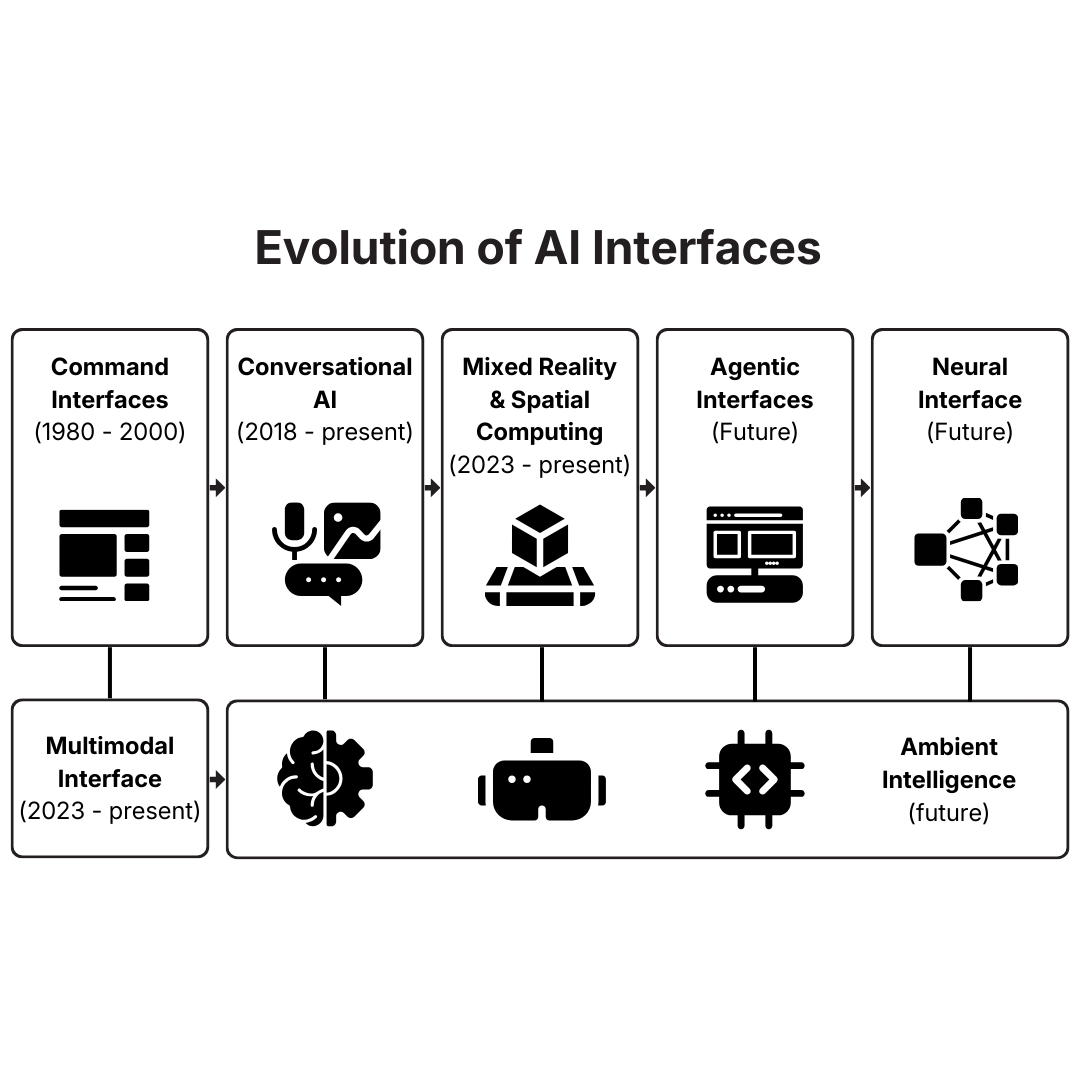
Artificial intelligence has long been shaped not only by improvements in algorithms and computational power, but also by the interfaces that allow humans to engage with intelligent systems. Interfaces define boundaries of interaction, influence user experience, and ultimately determine how AI integrates into daily life. As AI becomes progressively more capable, the question shifts from what AI can do to how humans and machines communicate effectively, intuitively, and safely.
This chapter explores the evolution of interfaces for AI, spanning current technologies such as voice, multimodal input, mixed reality environments, APIs, and agent frameworks, and projecting future paradigms including neural interfaces, brain–computer communication, and ambient intelligence. The goal is to understand how these interfaces reshape cognition, workflow, creativity, and human–machine collaboration.
Artificial intelligence interfaces are undergoing a transition from explicit interaction modalities, such as text-based queries, to more fluid, natural, and ambient forms. AI is moving closer to human communication patterns, reducing friction between intention and action. This evolution is not merely an ergonomic improvement; it fundamentally changes how knowledge is accessed, how work is performed, and how people perceive the boundaries between software and agency. As interfaces expand, AI shifts from being a discrete tool used in isolated tasks to becoming an integrated cognitive partner embedded in the environment.
Foundations of AI Interfaces: From Commands to Conversations
Early AI interfaces relied on rigid command structures that mimicked traditional computing. Users had to understand syntax, formatting, and system constraints. Even early digital assistants offered limited interactions, requiring specific trigger phrases and providing minimal adaptability. As machine learning advanced, interfaces moved toward conversational paradigms where models could interpret ambiguous phrasing, evolving context, and user intention.
The shift toward conversational interaction represents a fundamental transformation. Instead of the user adjusting to the system, the system adapts to the user. Natural language processing allows users to express goals in everyday language, reducing cognitive load and enabling more spontaneous use. Conversational interfaces also expand accessibility, allowing individuals with limited technical expertise or physical impairments to engage with AI systems more directly.
Modern conversational models handle not only text but also multimodal cues, including voice, images, documents, gestures, and environmental signals. They integrate context over time, remembering prior interactions and refining interpretations as conversations unfold. This progression reflects a broader trend: interfaces evolve as AI becomes more capable of understanding, anticipating, and adapting to human needs.
This foundation is crucial for understanding how interfaces will evolve further, as the boundaries between human communication modes and machine interpretation continue to blur.
- Specific trigger phrases required
- Limited adaptability
- Expert users only
- Interprets ambiguous phrasing and evolving context
- Multimodal: voice + text + image
- Expands accessibility for non-technical users
- Ideal for environments where typing is impractical
- Affective computing: adapts to tone, pacing, inflection
- Privacy challenge: captures unintended utterances
Last updated: March 12, 2026