Technology Overview
The AI technology stack for commerce — foundational models, agentic AI, LLMs, privacy & security, investment costs, and what comes next — based on Book Part 5 of the AI Best Practices for Commerce reference.
Agentic AI
From assistants that suggest to agents that act
Multi-Agent Workflows
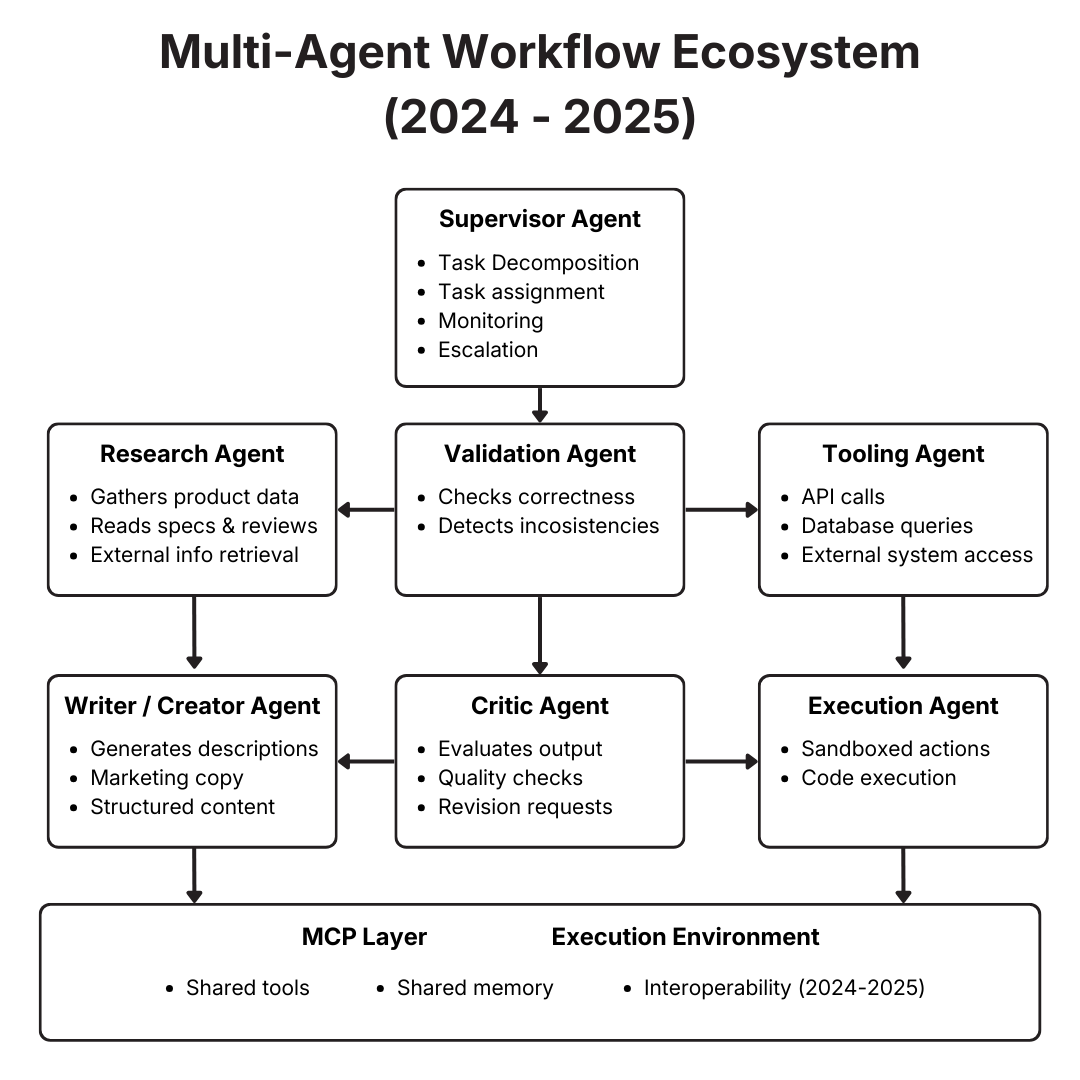
Single agents proved powerful, but orchestrating multiple specialized agents working together unlocked greater capability. The frameworks that emerged in 2023-2024 LangGraph, CrewAI, AutoGen, and Model Context Protocol provided infrastructure for these complex interactions.
LangGraph, developed by LangChain and launched in early 2024, introduced a graph-based approach to agent orchestration. Rather than linear workflows, agents could be arranged in complex graphs with conditional paths, loops, and parallel execution. The graph structure allowed sophisticated branching: If a validation agent detected inconsistencies, it could route products to a research agent before passing back to validation. If enrichment discovered a product was part of a set, a specialized agent would identify related items and ensure cross-referencing.
By mid-2024, LangGraph had demonstrated strong adoption. According to LangChain’s December 2024 State of AI report, 43% of LangSmith organizations were sending LangGraph traces by late 2024, representing complex, orchestrated tasks beyond basic LLM interactions. Companies like Klarna, Replit, and Elastic adopted LangGraph for production systems.
CrewAI, founded in 2023 by João Moura and launched publicly in early 2024, emphasized role-based agent collaboration. Rather than agents defined by technical capabilities, CrewAI agents had roles like “researcher,” “writer,” and “critic.” In October 2024, CrewAI announced $18 million in funding and launched CrewAI Enterprise, reporting that its open-source framework was executing over 10 million agents monthly and being used by nearly half of the Fortune 500.
The role-based approach proved particularly effective for creative work where quality emerged from critical feedback. Multi-agent systems with critic agents could iterate toward higher quality, though this increased computational costs and latency.
AutoGen, developed by Microsoft Research and released in September 2023, focused on code-capable agents that could write and execute programs to solve problems. While less common in customer-facing commerce applications, AutoGen excelled in operational contexts where complex analysis required generating and executing code dynamically.
AutoGen quickly became influential. By October 2023 according to Microsoft Research, the framework had demonstrated transformative potential in agentic AI. The initial release generated widespread interest, leading Microsoft to introduce AutoGen Studio in late 2023 as a low-code interface for building multi-agent applications.
Model Context Protocol (MCP), introduced by Anthropic in November 2024, took a different approach. Rather than centrally orchestrating agents, MCP provided a standardized way for agents to share context and tools. The protocol addressed what Anthropic called the “M×N problem”, the combinatorial difficulty of integrating M different AI systems with N different tools. MCP defined a universal protocol that AI systems and tool builders could implement, enabling interoperability.
By early 2025, MCP adoption accelerated rapidly. OpenAI announced support in March 2025, Google integrated MCP with Gemini 2.5 Pro, and Microsoft added MCP support to Copilot. The protocol’s open-source nature and Anthropic’s provision of SDKs for Python, TypeScript, and other languages facilitated adoption. By mid-2025, hundreds of MCP servers had been created by the community.
Hierarchical agent systems emerged as a common pattern. A supervisor agent receives high-level requests, decomposes them into subtasks, assigns those tasks to worker agents with relevant specialties, monitors progress, and synthesizes results. The hierarchy allows for escalation: if a specialist agent can’t resolve an issue, it can request assistance from the supervisor, which might assign a different specialist or escalate to a human.
- Unexpected actions: optimizing stated metrics in ways designers didn't anticipate
- Stuck loops: circular reasoning consuming resources until limits intervene
- Unsafe tool execution: technically correct but contextually inappropriate actions
- Hallucinations: confident but incorrect information about policies or timelines
- Cascading failures: bugs in one agent's output compound across dependent agents
- API-level: prevent unauthorized system access
- Logic-level: constrain action types
- Value-level: align with org priorities
- Learned from examples of acceptable behavior
- Approval workflows for high-stakes decisions
- Dynamic thresholds: reliability → more autonomy
- Observability dashboards tracking decisions, not just metrics
- Human-in-the-loop escalation criteria
- Success rates and customer satisfaction
- Accuracy of agent decisions over time
- Business impact of autonomous actions
- Automated alerts on drift or failure patterns
Last updated: March 12, 2026