Technology Overview
The AI technology stack for commerce — foundational models, agentic AI, LLMs, privacy & security, investment costs, and what comes next — based on Book Part 5 of the AI Best Practices for Commerce reference.
Agentic AI
From assistants that suggest to agents that act
The Agentic Commerce Model
The traditional ecommerce architecture followed a simple path: customer → interface → backend → fulfillment. Humans made decisions at multiple points, what to search for, which products to list, how to price items, when to run promotions. Even automated decisions reflected frozen human judgment, rules someone had programmed months earlier.
Agentic systems invert this model. Instead of humans making decisions and AI executing them, agents make decisions within guardrails humans establish. The shift is subtle but consequential.
Buyer agents emerged most visibly. Amazon announced Rufus, an AI-powered shopping assistant, in February 2024. Initially available to select U.S. customers, Rufus went to full U.S. availability in July 2024. The system, trained on Amazon’s product catalog, customer reviews, and information from the web, handles queries like “help me prepare for a camping trip in cold weather” by assembling complete recommendations. According to Amazon’s November 2024 earnings call, customers who engage with Rufus are 60% more likely to complete purchases compared to those who don’t use the assistant, with the company projecting over $10 billion in incremental annual sales from the system.
The distinction from traditional search matters. Rufus doesn’t just match keywords, it researches products, compares options, checks reviews, and synthesizes recommendations. The agent operates between the customer and Amazon’s catalog, interpreting intent and orchestrating information retrieval.
Beyond customer-facing applications, the agent architecture promises to restructure behind-the-scenes operations. Agents could manage inventory by monitoring sales patterns, predicting stockouts, researching alternative suppliers, and initiating purchase orders. They could optimize pricing by analyzing competitor behavior, demand elasticity, and profit margins, adjusting rates multiple times daily. They could handle content generation, creating product descriptions, marketing copy, and social media posts adapted to different channels and audiences.
The ecosystem implications intrigue technologists. If buyer agents negotiate with seller agents, both optimizing for their principals, what happens to pricing transparency? If agents make purchasing decisions autonomously, how do brands build loyalty? If most commerce flows through agent-to-agent negotiations, what role remains for traditional storefronts?
These questions remain largely theoretical in late 2025. Most deployed “agents” operate under significant constraints, with humans approving major decisions. But the trajectory suggests increasingly autonomous systems handling progressively more complex tasks.
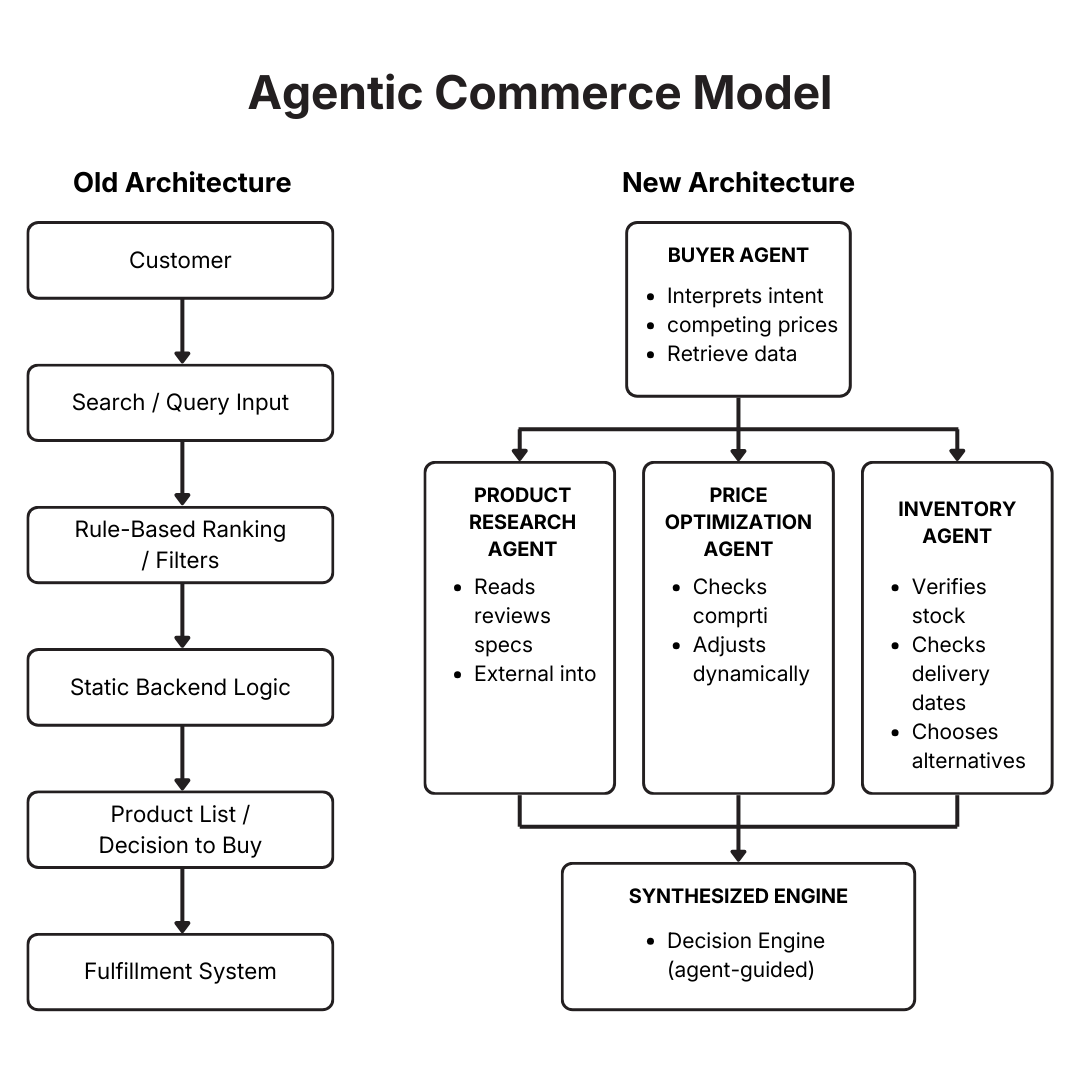
- Interprets customer intent and goals
- Researches products across sources
- Compares options and synthesizes recommendations
- Inventory Agent: monitors stock, checks delivery dates, chooses alternatives
- Price Optimization Agent: checks competitors, adjusts dynamically
- Content Agent: generates descriptions, marketing copy, social posts
- Decision engine coordinates agent outputs
- Guardrails define boundaries for autonomous action
- Escalation rules send edge cases to human reviewers
Last updated: March 12, 2026